
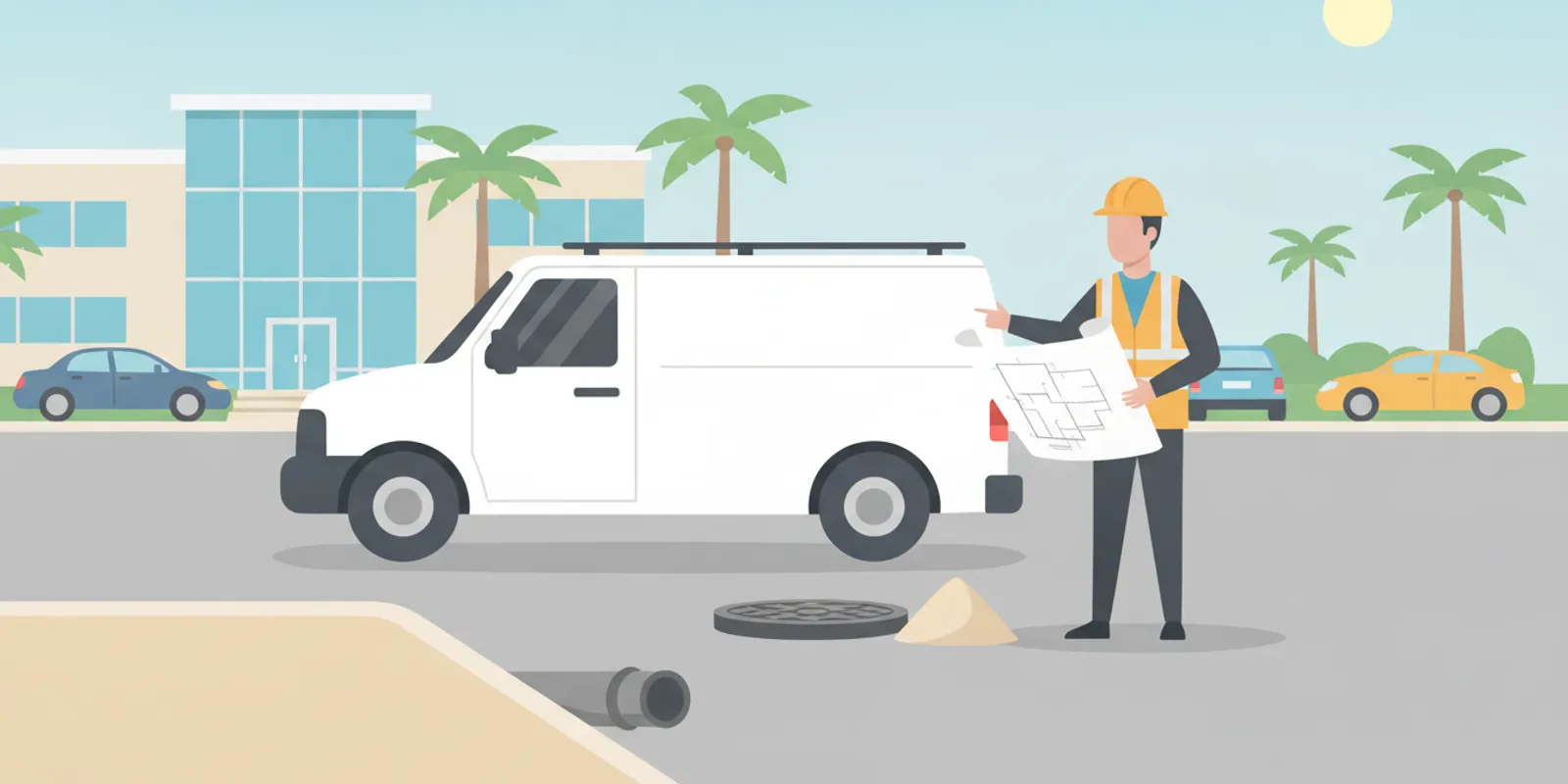
When a sewer line fails beneath pavement, trenchless sewer repair for a parking lot may offer a way to rehabilitate or replace the pipe without opening a continuous trench across the paved area. The right approach depends on what inspection shows, the pipe’s condition, available access, and how the lot is used. Understanding those factors helps property owners and facility teams ask better questions before work begins.
Request a parking lot pipe evaluation
Why consider trenchless sewer repair beneath a parking lot?
In brief: Limited-access repair may reduce the pavement opened, but a site assessment determines the actual disruption and fit.
A sewer line under a parking lot can be difficult to reach with conventional excavation. A trench may require removal and later restoration of asphalt, concrete, pavement markings, landscaping, or other site features. The scope depends on the line’s depth and route, the surface above it, and the room available for equipment and excavation.
Trenchless methods are designed to repair or replace a pipe through limited access points rather than expose its full length. That can reduce the amount of pavement disturbed, but it does not mean every project is excavation-free. Crews may still need access pits, cleanouts, or localized excavation. A camera inspection and site review help establish what is feasible before a method is selected.
For a property manager, the practical question is not simply whether a method is called trenchless. Ask what surface areas must be opened, where equipment will be placed, which parts of the lot need temporary controls, and how the repair will be checked. These details connect the pipe work to the property’s daily use.
Pipe Surgeons focuses on pipe diagnostics and rehabilitation, including trenchless pipe repair. Its service information describes approaches such as pipe lining and pipe bursting. A site-specific assessment is needed to determine whether either option fits a particular parking lot.
What should an inspection establish before choosing a repair?
In brief: Confirm the defect location, pipe condition, access, and inspection limits before selecting a repair method.
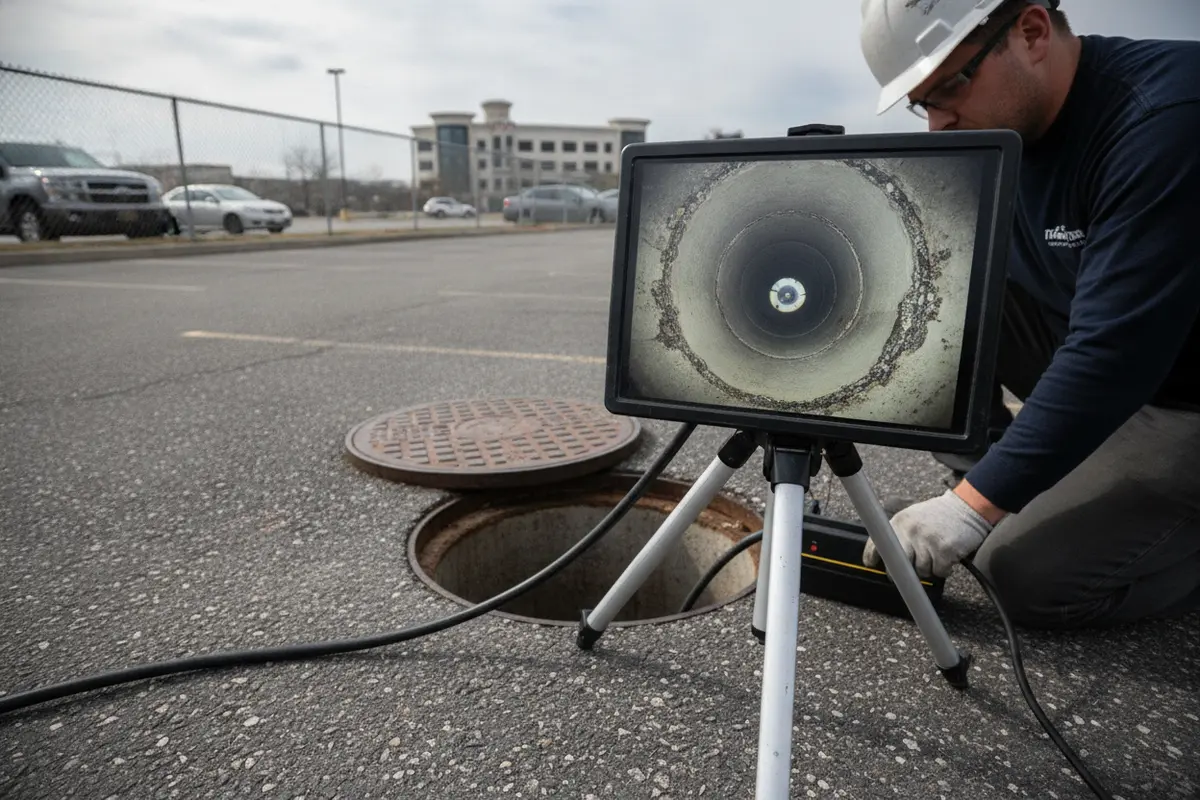
Before comparing repair methods, establish where the affected line runs and what condition it is in. A sewer camera inspection can help document the pipe interior and locate visible concerns. The findings can guide the next questions, but a camera view is only one part of planning; the location, access, and use of the site matter too.
Ask the pipe specialist to explain the inspection findings in plain language. Useful details include the approximate location of the defect, whether it appears isolated or extends along a section, signs of a restriction or offset, and whether the camera could travel through the area. Ask what the video can confirm and what it cannot. If the line cannot be fully inspected, clarify what additional diagnostic step may be appropriate.
It also helps to gather existing site information before the evaluation. Share available utility plans, prior repair records, known cleanout locations, and any recurring backup or odor history. Mark where problems have appeared, such as a floor drain, restroom, or exterior access point. Do not assume that the closest visible symptom sits directly above the damaged pipe.
- Map the operating area: Identify drive lanes, loading zones, accessible parking, fire access, delivery times, and busy periods.
- Locate known access: Note cleanouts, manholes, and other points the inspection team may be able to use.
- Document symptoms: Record when backups, slow drainage, or odors occur and which fixtures or areas are affected.
- Share site records: Provide drawings or prior inspection footage if available, while noting that records may not show current conditions.
How do pipe lining and pipe bursting differ?
In brief: Lining rehabilitates a suitable existing pipe; bursting replaces it along a route that can accommodate the equipment.
Pipe lining and pipe bursting are different trenchless strategies. A liner rehabilitates an existing pipe from the inside, while bursting breaks apart an existing pipe as a new pipe is pulled into its path. Their requirements and suitability differ, so neither should be treated as an automatic choice for every parking lot.
With cured-in-place pipe (CIPP) lining, a liner is installed within a host pipe and cured to form a lining. The method relies on the existing pipe path and requires the host pipe to be suitable for that work. The contractor should explain preparation, access, curing, connections, and inspection steps for the proposed project. Read more about CIPP pipe lining and when CIPP may be considered.
Pipe bursting uses equipment to fracture or displace the existing pipe while drawing a replacement pipe into place. It typically requires access at the ends of the replacement run and enough room to position the equipment. The route, material, depth, nearby utilities, and site conditions all affect planning. The City of Deer Park’s specification describes a pipe-bursting replacement system for streets, driveways, parking lots, and sidewalks; it is one example of a public project specification, not a universal design rule. See the City of Deer Park pipe-bursting specification.
| Planning question | Pipe lining | Pipe bursting |
|---|---|---|
| What happens to the existing pipe? | A liner is installed inside a suitable host pipe. | The existing pipe is fractured or displaced as a replacement pipe is pulled through. |
| What should inspection clarify? | Whether the existing pipe and its route can support lining, plus preparation and connection details. | Whether the route, surrounding conditions, and access can support pulling in a replacement pipe. |
| What site planning is important? | Access for cleaning, liner installation, curing, and post-work checks. | Access and working room at required entry and receiving points, with utilities and surface use considered. |
| What is the decision point? | Choose only if the pipe condition and project requirements are suitable for lining. | Choose only if the site and pipe route allow replacement by bursting. |
The table is a starting point for discussion, not a substitute for a pipe assessment. Ask the contractor to connect the recommendation to documented conditions. If the proposal names a method without explaining why it fits the inspected pipe and the property’s constraints, ask for that reasoning before comparing bids.

What does a parking lot repair plan need to cover?
In brief: A workable plan accounts for access, staging, traffic, business hours, surface restoration, and post-repair verification.
A good plan accounts for both the underground work and the surface above it. Start by asking for the proposed work area and access points to be identified on a site plan or marked on site. Then review how people, vehicles, and deliveries will move while the work is under way. The exact controls depend on the property layout and the work scope.
A practical way to review the plan is to trace the work from arrival through closeout. First, identify the work zone and a safe route for equipment and materials. Next, decide which drive aisles, spaces, entrances, or loading areas need temporary restrictions. Then confirm how the team will maintain essential access and notify occupants. Finally, agree on what inspection record and surface-restoration check will mark completion. This sequence gives the property team specific points to verify rather than a general assurance that disruption will be limited.
Access and work area
Confirm the points crews will use and the space needed for equipment, materials, and any excavation. Ask whether the work could affect adjacent utility lines, landscaping, curbs, sidewalks, or building access. If the pipe runs below a drive lane, loading area, or entrance, discuss whether the sequence can keep another route available. Do not assume that a small access point means a small staging area.
Traffic and business operations
Coordinate work windows with the people who use the lot. A shopping center, apartment property, restaurant, medical facility, and municipal site may have different peak periods and access needs. Tell the pipe contractor about delivery schedules, accessible parking needs, emergency access requirements, and any rules the property must follow. Agree on who will communicate closures or route changes to occupants and visitors.
Where work touches a public road or public right-of-way, identify who is responsible for checking applicable permit and traffic-control requirements. The City of Eugene’s project record describes trenchless sewer lateral repair in a roadway under an encroachment permit. That record illustrates why public-space coordination can matter; it does not establish what a separate property needs. See the City of Eugene project record.
Restoration and verification
Ask what pavement or other surfaces may need to be opened and how disturbed areas will be restored. Clarify whether restoration is part of the proposed scope or coordinated separately. Discuss how the completed pipe will be checked, what records or video will be provided, and how connections and flow will be evaluated. The closeout method should match the repair method and the project specification.
For a municipal, industrial, or multi-tenant site, identify who needs the inspection record and what format is useful. A clear record can help the owner maintain a history of the line and communicate the work to future facility teams. Pipe Surgeons serves different property types; readers can review its industry service information to see the types of clients it addresses.
What questions help compare proposals?
In brief: Compare the pipe section, evidence, access, operating impacts, restoration, and closeout, not the method label alone.
Compare proposals by scope and assumptions, not just by the method name. Two quotes may address different pipe lengths, access needs, or restoration work. Before choosing a contractor, ask for a plain explanation of what is included and what could change if inspection reveals different conditions.
It can help to place proposals side by side and mark each item as included, excluded, or still unknown. For example, one scope may include pipe rehabilitation and a post-work camera check while leaving pavement striping to the property owner; another may define restoration differently. Ask each contractor to clarify the same open items before comparing totals. That makes differences visible without assuming that two proposals cover identical work.
For a quote-based project, the scope and site conditions determine what is proposed; avoid relying on a generic price or a promise that every job will avoid all surface disruption. Pipe Surgeons describes its services and repair options online, including pipe repair and inspection services. You can also review its company background before deciding what information to request.
When should a property team request an evaluation?
In brief: Request an evaluation for recurring sewer symptoms, a suspected line problem under pavement, or before paving work makes access decisions urgent.
Consider a professional evaluation when a sewer concern appears to involve a line beneath pavement, when symptoms recur after an earlier clearing, or when planned site work makes the pipe’s condition important to understand. Repeated backups, an unexplained change in drainage, or evidence of a leak can have multiple causes. Inspection helps identify whether a sewer line is involved rather than assuming the lot surface is the source.
If wastewater is actively backing up or there is a suspected leak, treat it as a prompt service issue and keep people away from affected areas as appropriate. Do not drive over a suspected void or open a manhole to investigate. Share the symptoms and site access details with a qualified pipe professional so the next step can be determined safely.
A planned evaluation is also useful before repaving, restriping, or changing how a commercial lot is used. If a sewer line is already showing a problem, coordinating pipe work with surface projects may help the property team understand the full sequence. It is still important to base decisions on the inspection and project plan, not only on the timing of paving work.
Discuss a parking lot sewer line
Frequently asked questions about parking lot trenchless repair
Will trenchless repair mean no pavement has to be opened?
Not necessarily. Trenchless methods aim to avoid a continuous trench, but a project may need access points or localized excavation. The contractor should identify likely openings and restoration needs after reviewing the pipe and site.
Can a pipe be lined if it has a major defect?
It depends on the defect, the condition of the host pipe, and the lining system proposed. Camera findings help inform that decision, but the pipe specialist should explain whether the specific condition is suitable for lining or whether another approach needs to be considered.
Is pipe bursting always better for a parking lot?
No. Pipe bursting can replace a pipe along a suitable route, but access, nearby utilities, pipe conditions, and site constraints matter. A recommendation should be based on the inspected line and a review of the property, not the surface type alone.
How can a business keep the lot usable during repair?
Discuss staging, access points, work timing, vehicle routes, deliveries, and areas that need to remain open before work is scheduled. The contractor and property team can then coordinate a site-specific sequence and communicate any temporary restrictions.
What should be included in the project closeout?
Ask what post-repair inspection, video, or written record will be provided, and confirm that it covers the repaired section and any agreed checks. Keep that record with site plans and prior pipe documents for future facility decisions.
Plan the next step for your parking lot sewer line
Each parking lot has its own pipe route, access limitations, and operating schedule. A camera-based assessment and a clear site plan can help you understand whether lining, pipe bursting, or another response is appropriate and what pavement or traffic coordination may be needed.
Request a site-specific pipe assessment
With the inspection findings and project requirements in hand, your property team can make a more informed decision about repair scope, site coordination, and the next steps.